

Just as a master sommelier can distinguish a vintage Bordeaux from a house red with a single sip, a true collector of fine art photography knows that the value of a piece extends far beyond the image itself. When you step into the world of high-end collecting, you aren't just buying a picture; you are investing in a physical object designed to withstand the test of time. Understanding what constitutes a "museum quality" print is your first step toward building a legacy collection that retains its vibrancy and value for generations.
Whether you are browsing the curated galleries at Edin Fine Art or looking to produce your own work through Edin Studios, the technical specifications of the print are what separate a temporary decoration from a true investment. This guide will walk you through the essential pillars of archival excellence, ensuring you have the confidence to choose pieces that are truly world-class.
Defining the Standard: What Does Museum Quality Actually Mean?
Many people assume that any high-resolution photo is a candidate for a gallery wall, but the reality is much more rigorous. A museum-quality print is defined by three non-negotiable pillars: archival stability, color accuracy, and material excellence. When you hold a professional print, it should feel substantial, almost like a piece of fine fabric, signaling that it was crafted with permanence in mind.
| Feature | Museum Quality (Archival) | Standard Photo Print |
|---|---|---|
| Ink Type | Pigment-based (Carbon) | Dye-based |
| Paper Base | 100% Cotton Rag or Alpha Cellulose | Plastic-coated (Resin) |
| Longevity | 100+ Years | 10–20 Years |
| Acidity | Acid-free & Lignin-free | May contain acids that yellow over time |
| Detail | High dynamic range, deep blacks | Potential for "crushed" shadows |
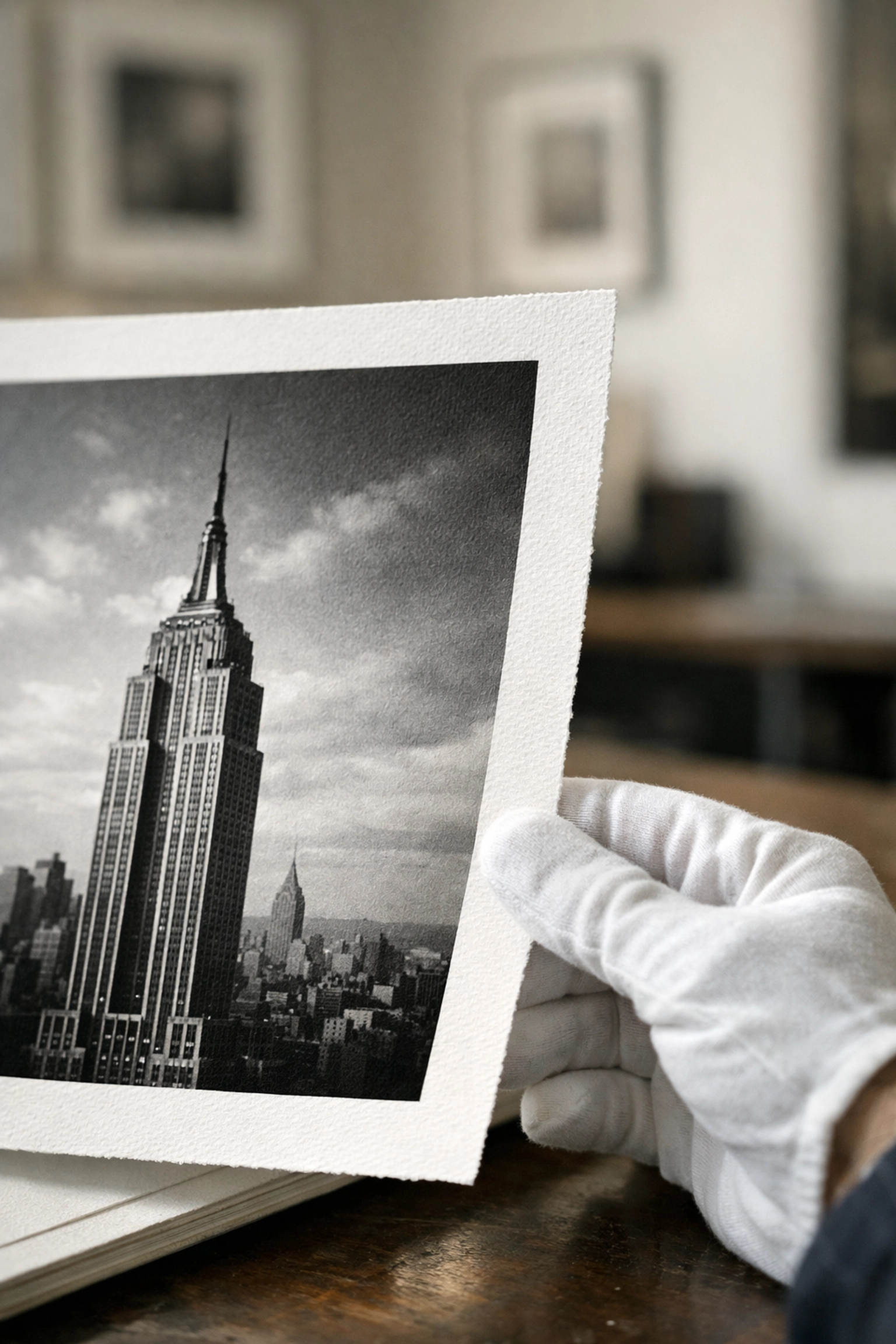
Alt Text: A close-up, ultra-realistic shot of a gloved hand inspecting a thick, textured fine art photography print of a New York City skyline, highlighting the rich detail and archival paper quality.
The First Pillar: Archival Stability
The most critical factor for you as a collector is archival stability. This is the print’s ability to resist fading, cracking, and yellowing despite exposure to light and humidity. To achieve this, the materials used must be 100% acid-free and lignin-free. Lignin is a natural component in wood pulp that, if left in paper, causes it to turn yellow and brittle: think of an old newspaper.
When you invest in archival prints, you are ensuring that the chemical makeup of the paper is inert. This prevents the deterioration that plagues cheaper alternatives. By choosing prints that meet these standards, you are securing an asset that can be passed down through your family, maintaining the same visual impact it had the day it was printed.
The Second Pillar: Pigment vs. Dye Inks
Your understanding of ink technology is what will ultimately protect your investment. Most consumer-grade printers use dye-based inks, which are essentially colored liquids that soak into the paper. While they can look bright initially, they are highly susceptible to UV damage and will fade within a decade or two.
In contrast, museum-quality prints utilize pigment-based inks. These are tiny, solid particles of color suspended in a liquid carrier. These particles bond to the surface of the fine art paper and are incredibly resistant to light and environmental gases. This process, often referred to as Giclée printing, ensures that the deep blacks stay deep and the vibrant oranges of a sunset: perhaps captured using my New York City photography guide: remain just as striking fifty years from now.
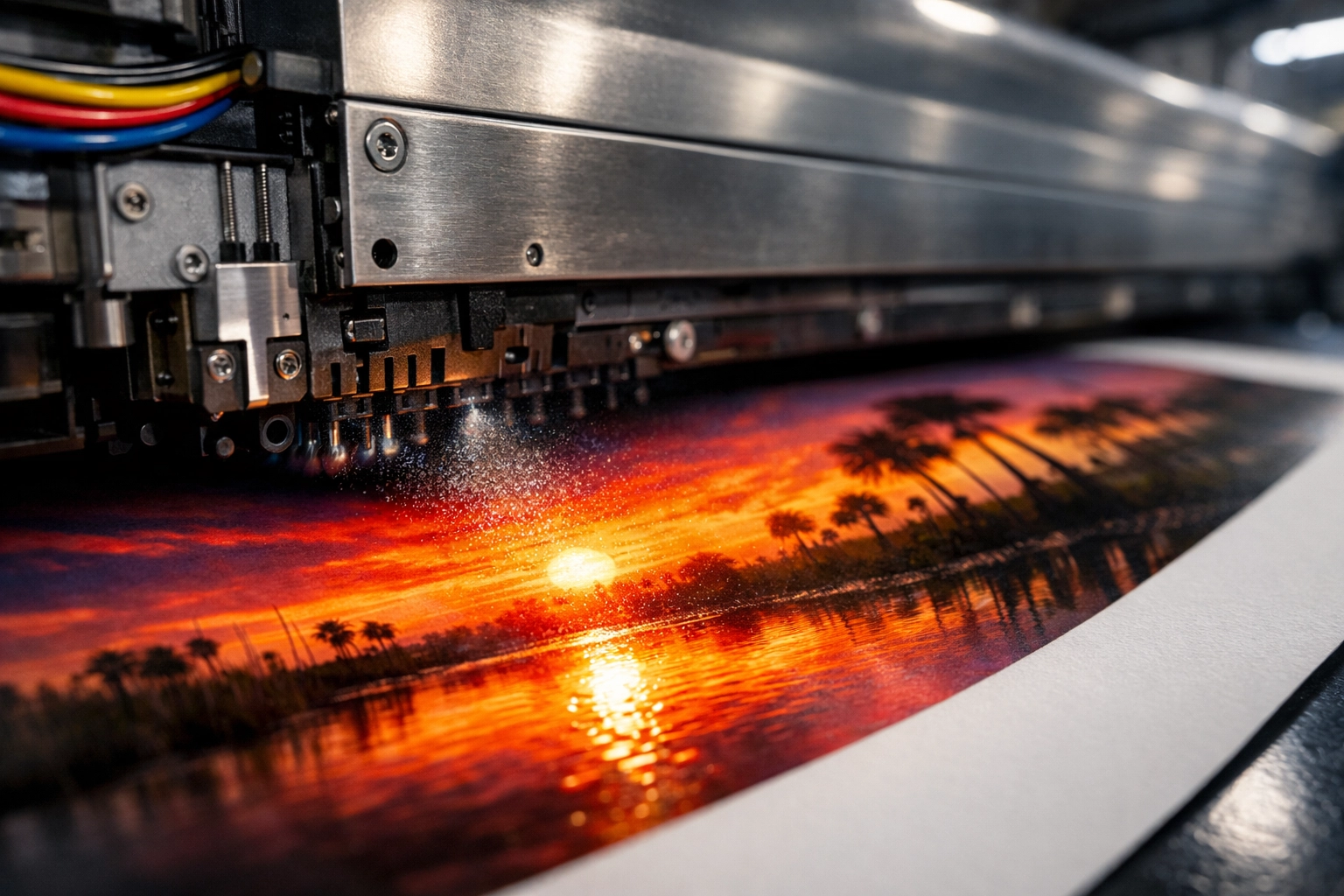
Alt Text: An ultra-realistic macro view of a professional wide-format Giclée printer head depositing pigment-based ink onto heavy 300gsm cotton rag paper, showing the intricate spray pattern and vivid color reproduction.
The Third Pillar: Material Excellence and Paper Choice
The substrate, or the material the image is printed on, is the soul of the artwork. As a collector, you should look for papers with a substantial weight: typically 300gsm (grams per square meter) or higher. These papers, often produced by historic mills like Hahnemühle or Canson Infinity, offer a tactile quality that is unmatched.
- Cotton Rag: Made from 100% cotton fibers, this is the gold standard for fine art. It is naturally acid-free and has a beautiful, soft texture.
- Baryta Paper: This paper features a barium sulfate coating that mimics the look of traditional darkroom prints. It offers "smooth as butter" tonal transitions and incredible black density (D-Max).
- Metallic and Acrylic: For modern interiors, some collectors prefer the sleek look of face-mounted acrylic, which provides a 3D-like depth to the image.
How to Evaluate a Print Like a Pro
When you are looking at a piece of fine art photography, you need to train your eye to see beyond the subject matter. Start by inspecting the "Black Density." Are the shadows rich and deep, or do they look "muddy" and grey? In a museum-quality print, you should see detail even in the darkest areas of the image.
Next, examine the resolution. A professional print is produced at a minimum of 300 DPI (dots per inch). This ensures that even when you stand inches away from the piece, there is no visible pixelation or "dots." The edges of buildings or the fine mist of a waterfall should be crisp and continuous.
For many photographers, achieving this level of detail starts in the editing room. Using the Ultimate Lightroom Preset Collection helps ensure that the raw file is optimized for the printing process, managing the tonal range so that nothing is lost when the ink hits the paper.

Alt Text: A professionally lit gallery wall in a luxury home featuring a large-format museum quality print of a landscape, with specialized art lighting highlighting the texture of the archival paper and the depth of the blacks.
The Importance of a Calibrated Workflow
One of the "insider secrets" of the art world is the color-managed workflow. This ensures that what the artist sees on their screen is exactly what ends up on your wall. This involves sophisticated hardware calibration of monitors and the use of ICC profiles: files that tell the printer exactly how to interpret colors for a specific type of paper.
This commitment to precision allows for perfect repeatability. If you were to purchase a limited edition print today and then see another from the same edition a year later, the colors should be identical. This level of consistency is a hallmark of professional operations and is something we prioritize at Edin Chavez Blog.
Protecting Your Investment
Once you have acquired a museum-quality print, your role as a collector shifts to preservation. Even the best archival prints can be damaged by poor handling.
- Framing: Always use UV-protective glass or acrylic to filter out harmful light rays.
- Matting: Ensure that the mat board used in framing is also 100% acid-free (museum board).
- Environment: Avoid hanging your art in direct sunlight or in areas with high humidity, such as bathrooms.
By following these protocols, you ensure that your fine art photography remains a vibrant center-point of your home for a lifetime.

Alt Text: A clean, minimalist workspace showing a photographer using a color calibration tool on a high-end monitor, with a stack of fine art photography prints and a loupe on the desk for inspection.
Final Thoughts for the Collector
Building a photography collection is an incredibly rewarding journey. It allows you to bring the beauty of the world: from the neon streets of Tokyo to the quiet majesty of the mountains: into your personal space. By insisting on museum-quality standards, you aren't just buying art; you are preserving a moment in time with the highest possible integrity.
When you are ready to add a new piece to your collection, remember to ask about the ink, the paper, and the archival process. True artists and reputable galleries will be proud to share these details with you.
For more insights on how to elevate your work, explore our site for a deep dive into hundreds of tutorials and guides at Edin Chavez Blog. Whether you are looking to master your own printing or find the perfect piece at Edin Fine Art, we are here to provide the expertise you need to succeed.
Hence, with these considerations in mind, you are now equipped to navigate the fine art market with the authority of a seasoned pro. Your walls deserve nothing less than the best.


